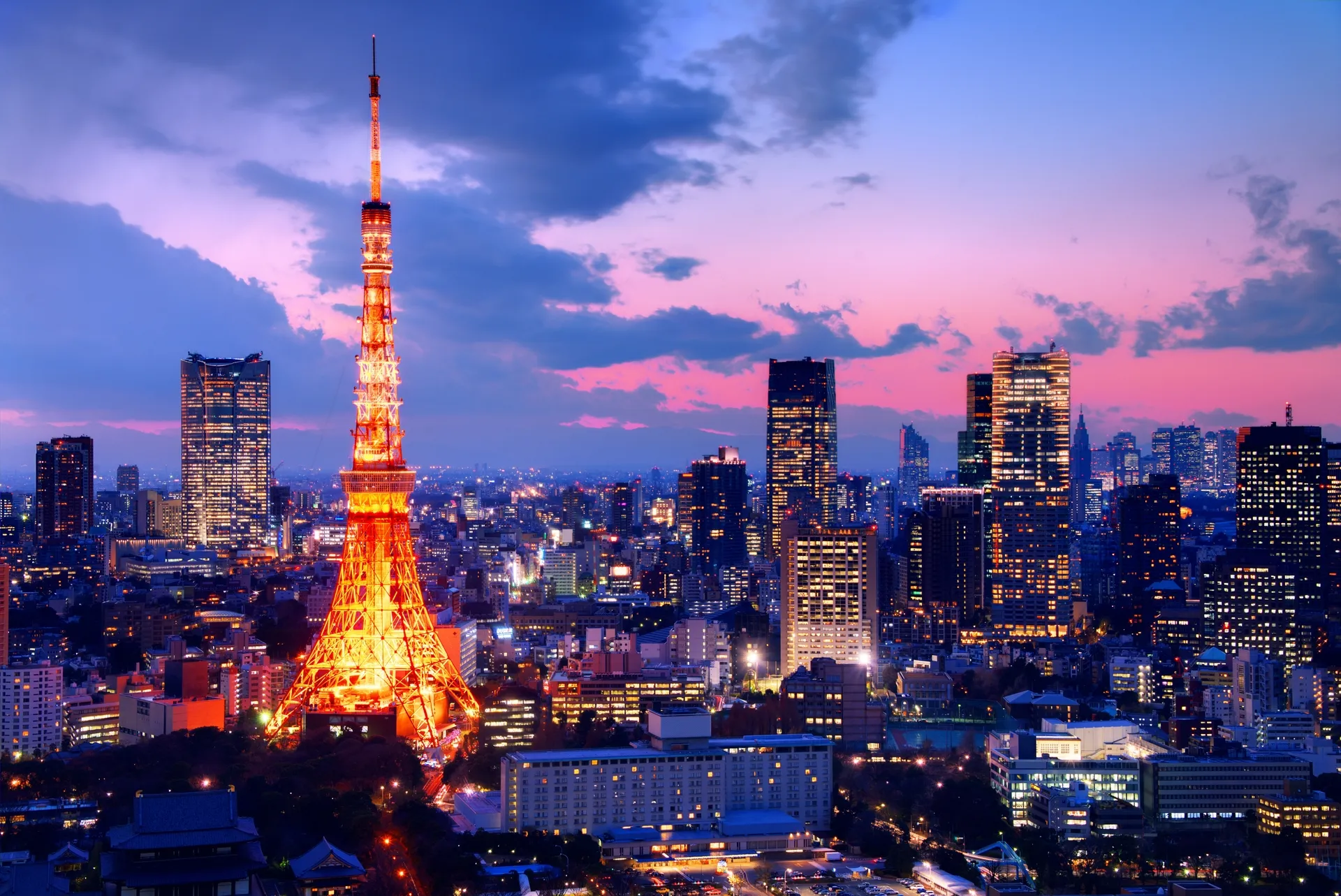
I've stood on nearly every observation deck in Tokyo squinting at the southwestern horizon, and I'll tell you this: seeing Mt. Fuji from the city is one of those travel moments that hits different. That snow-capped silhouette rising above 13 million people's worth of concrete — it stops you cold. But here's what nobody tells you before you buy that observation deck ticket: Fuji is stubborn. She hides behind clouds, haze, and humidity more often than she reveals herself. In this guide, I'm sharing everything I've learned about where, when, and how to actually see Mt. Fuji from Tokyo — including the view from my personal favorite, Tokyo Tower.
Can You Actually See Mt. Fuji from Tokyo?
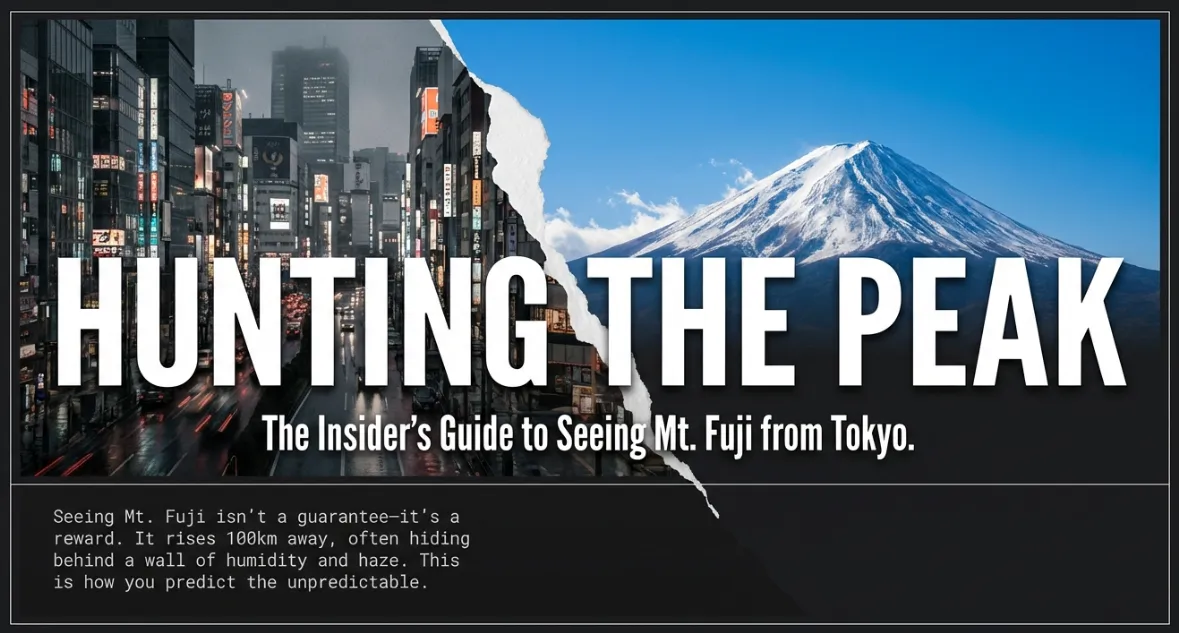
Yes — but it's far from guaranteed.
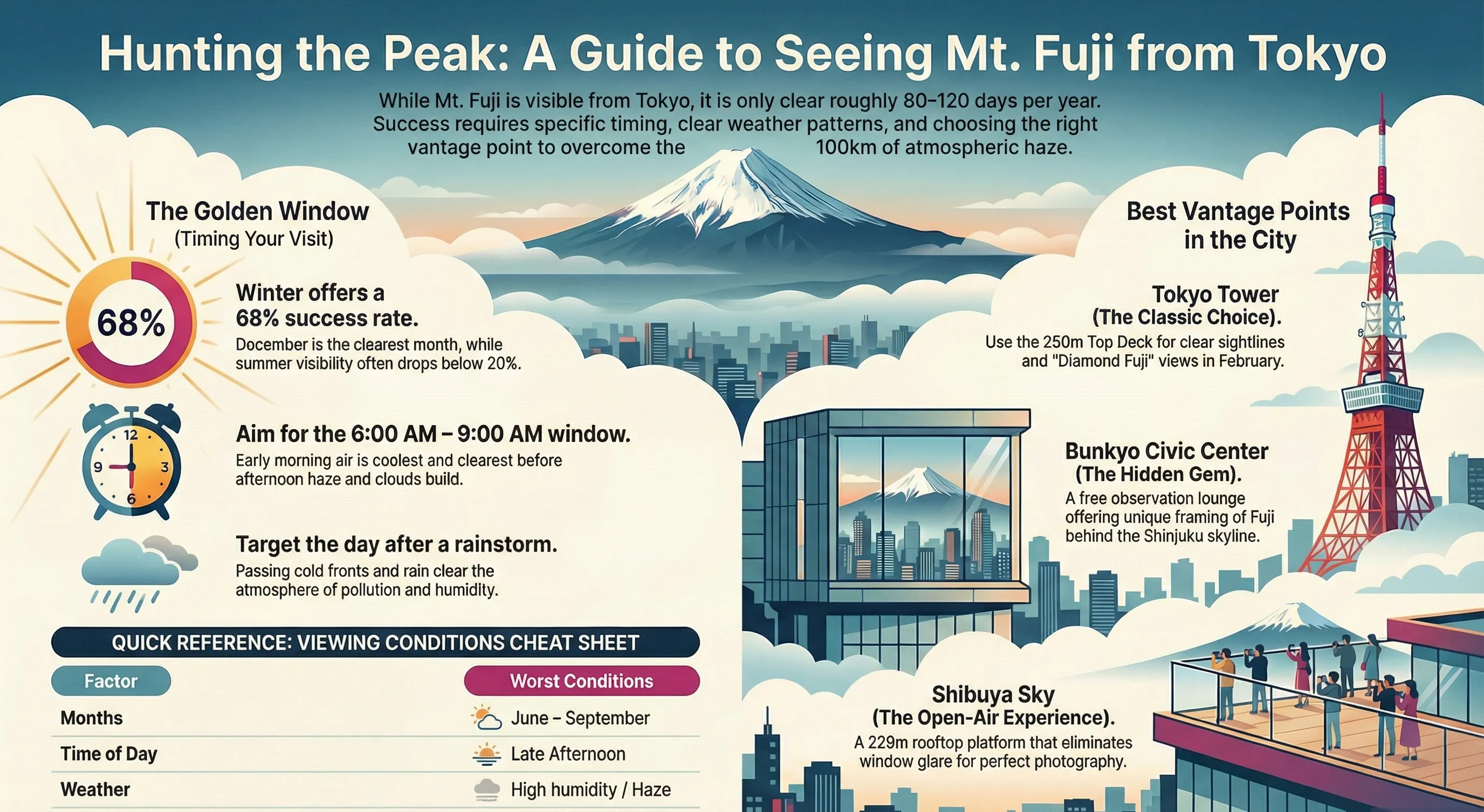
Mt. Fuji sits roughly 100 kilometers southwest of central Tokyo. At 3,776 meters, it's tall enough to peek over the urban sprawl on clear days, but that 100-kilometer gap is filled with humidity, pollution particles, and atmospheric haze that can render the mountain completely invisible even when the sky above you looks perfectly blue.
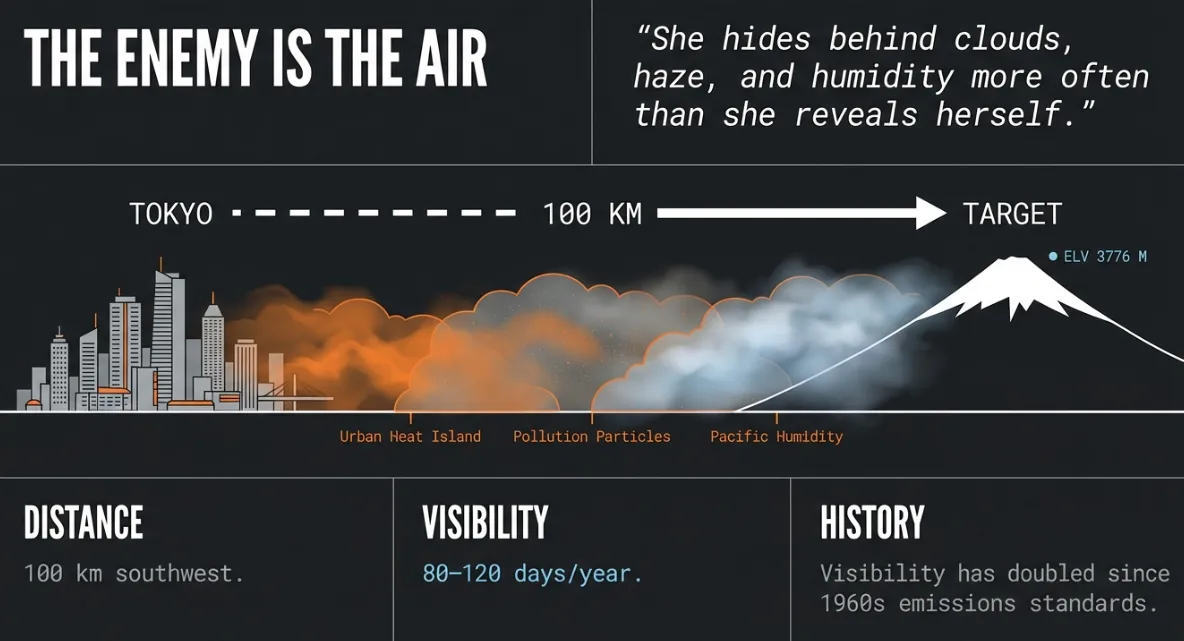
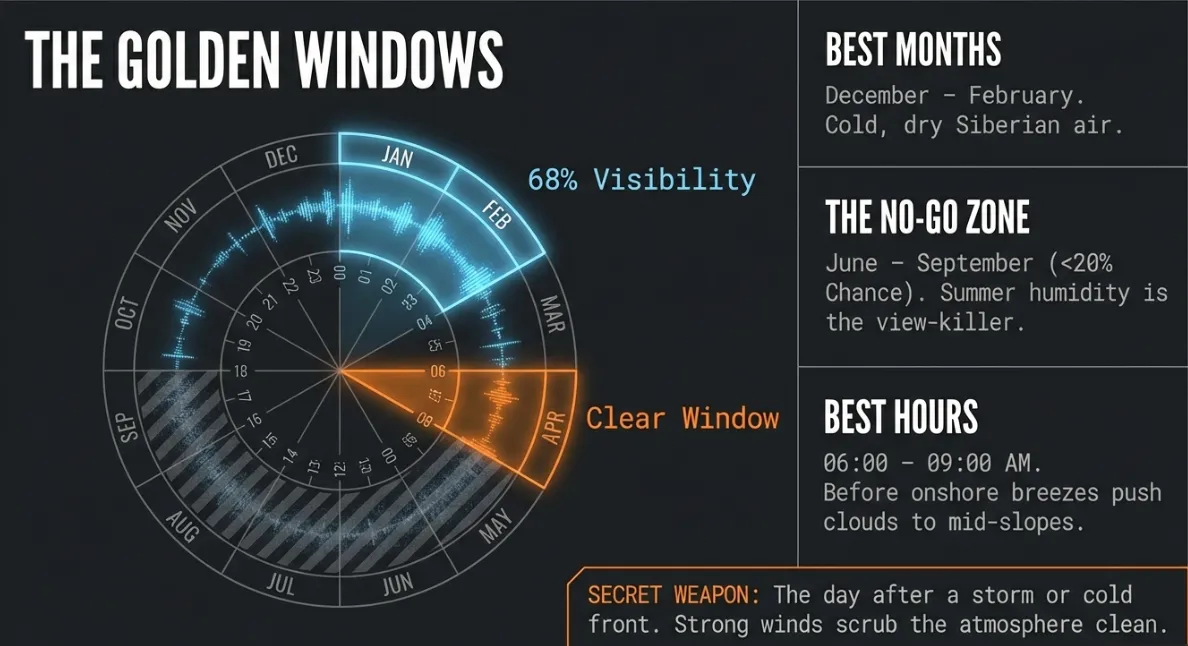
Here's the reality check: Mt. Fuji is clearly visible only about 80 to 120 days per year from the Tokyo area, depending on where you're standing and how strictly you define "visible." December is the best month, with roughly 68% of days offering clear or partial views. Summer? Forget it — July and August visibility drops below 20%.
The good news is that Tokyo's air quality has improved dramatically over the decades. Back in the 1960s and 70s, Fuji was visible from the city on average only about 43 days per year. That number has more than doubled thanks to stricter emissions standards. So your odds today are better than they've ever been.
When to Time Your Fuji-Hunting Mission
Getting the timing right is everything. I've wasted entire afternoons staring at milky horizons because I didn't follow these rules.
Best months: December through February. Cold, dry air from Siberian high-pressure systems pushes moisture out of the atmosphere. Winter also brings the bonus of a fully snow-capped peak — the postcard-perfect version of Fuji that most people picture.
Best time of day: Early morning, ideally between 6:00 and 9:00 AM. Overnight cooling settles the haze, and clouds haven't yet built up around the summit. By late morning, onshore breezes often push cumulus clouds onto Fuji's mid-slopes, blocking the view even on otherwise clear days.
The golden rule: The day after a rainstorm or cold front passes is often your best shot. Strong winds clear out the atmosphere, and the morning after a storm can produce jaw-dropping visibility where Fuji looks close enough to touch.
Worst time: June through September. The rainy season (tsuyu) from June through mid-July brings near-constant cloud cover, and summer humidity creates a stubborn haze that obscures anything beyond a few kilometers. Even if you're visiting in summer, early morning is your only realistic window.
Pro tip: Before heading to any observation deck, check the live webcam feeds at isfujivisible.com. If the cameras at Lake Kawaguchiko (which is much closer to the mountain) show a clear view, Tokyo has a fighting chance. If even those cameras show haze, save your money and visit the observation deck another day.
The View from Tokyo Tower: My Honest Take
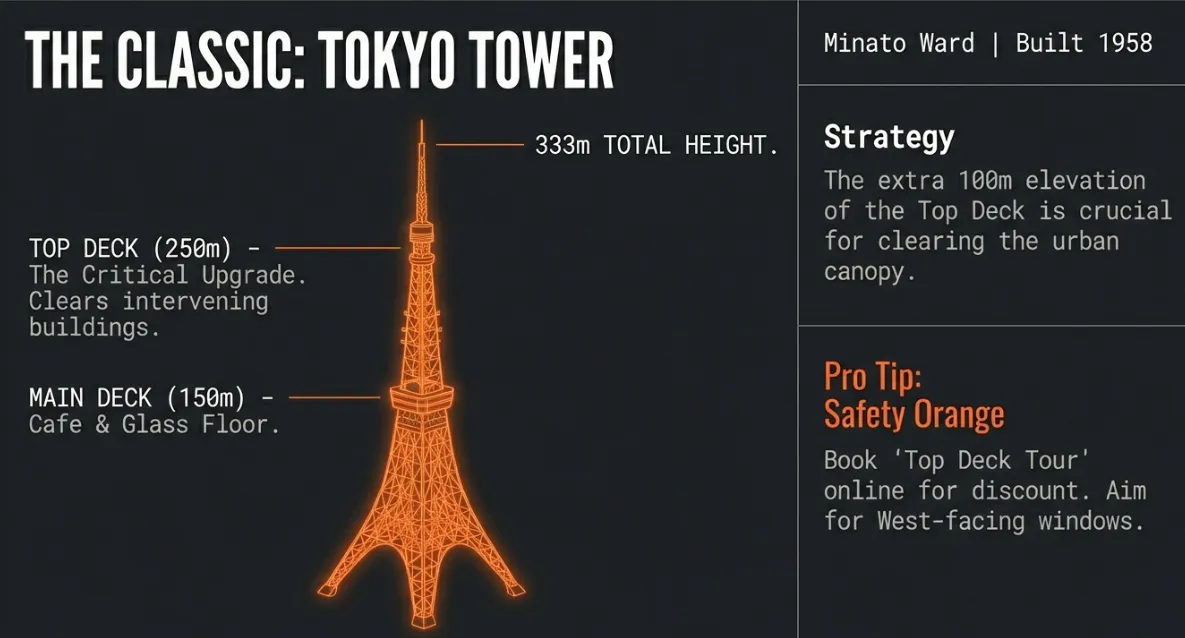
Tokyo Tower holds a special place in my Fuji-hunting story. Standing 333 meters tall in the Minato ward, it was built in 1958 and remains one of the most centrally located high-rise viewpoints in the city. Its position gives it clear sightlines toward the southwest — directly toward Mt. Fuji.
What You'll See (On a Good Day)
Tokyo Tower has two observation decks:
- Main Deck (150m): The lower deck is divided into two floors with a cafe, gift shop, and a glass floor section. Mt. Fuji is visible from the west-facing windows when conditions cooperate.
- Top Deck (250m): The higher observation experience. Accessed via a guided tour with atmospheric LED lighting and mirrors. The extra 100 meters of elevation gives a noticeably better chance of seeing over intervening buildings.
On a clear winter morning, you can see Fuji's snow-white cone rising unmistakably above the urban skyline. It's one of the most poetic contrasts in travel — Japan's most ancient natural icon framed by its most modern cityscape. At sunset on certain days in late January and early February (and again in mid-November), you can even witness "Diamond Fuji" — the phenomenon where the setting sun sits perfectly atop Fuji's summit, making it sparkle like a gemstone.
Tickets and Practical Info
| Ticket | Adult | High School | Child (Elementary/JHS) | Child (4+) |
|---|---|---|---|---|
| Main Deck (150m) | ¥1,500 | ¥1,200 | ¥900 | ¥600 |
| Top Deck Tour (150m + 250m, online) | ¥3,300 | ¥3,100 | ¥2,100 | ¥1,500 |
| Tokyo Diamond Tour (premium, 150m + 250m + Lounge) | ¥7,000 | ¥6,500 | ¥4,700 | ¥3,000 |
Hours: 9:00 AM – 11:00 PM (last admission 10:30 PM). The Top Deck Tour runs until 10:45 PM (last tour 10:15 PM).
My recommendation: If Fuji is your priority, book the Top Deck Tour online for the discounted price. Go early on a clear winter morning, and position yourself at the west-facing windows. Bring a zoom lens or binoculars — at 100 km away, Fuji is unmistakable but not enormous.
What If Fuji Doesn't Show?
Don't worry — the view from Tokyo Tower is spectacular regardless. You'll see Tokyo Skytree to the northeast, the Zojoji Temple and Shiba Park directly below, Rainbow Bridge and Tokyo Bay, and the sprawling Shinjuku skyline. The night view alone is worth the ticket price.
Ranking Tokyo's Best Observation Decks for Mt. Fuji Views
I've visited all of these, and here's how they stack up specifically for Fuji visibility.
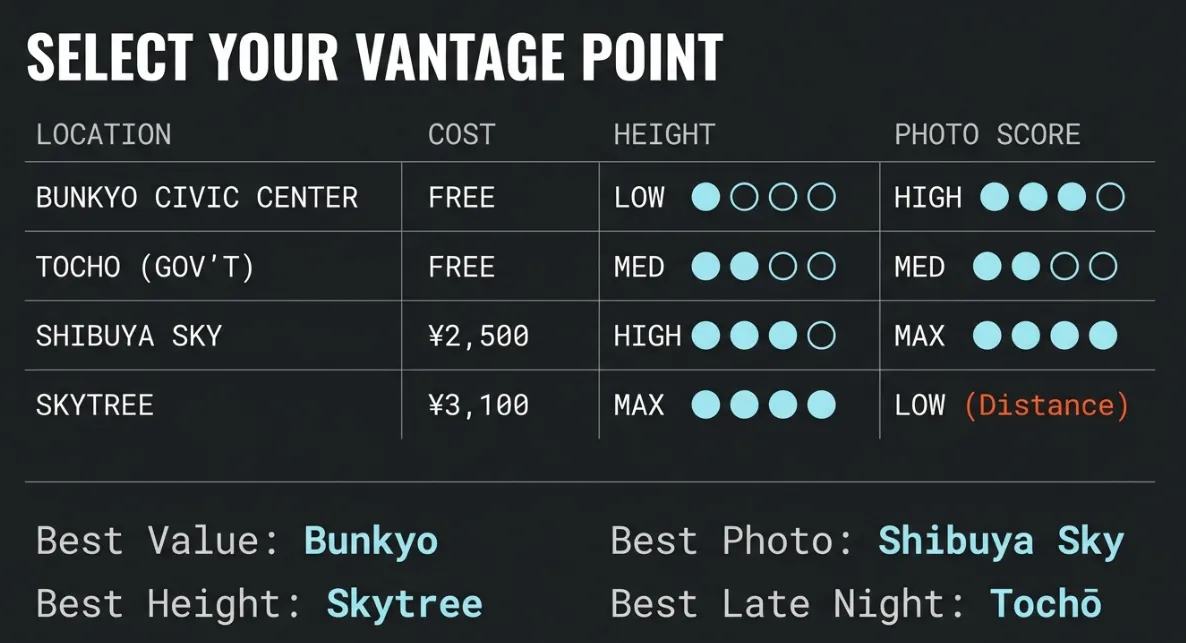
1. Bunkyo Civic Center — The Free Hidden Gem
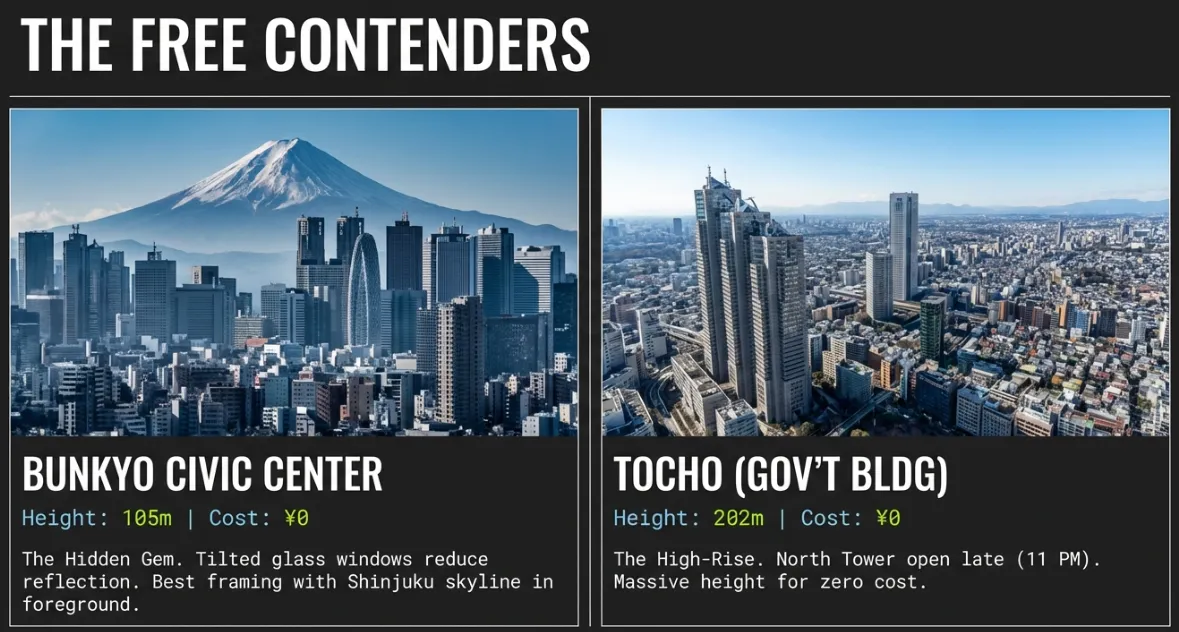
This is Tokyo's best-kept Fuji secret. The 25th-floor Sky View Lounge of the Bunkyo Civic Center sits at about 105 meters, which isn't the highest vantage point — but its central location and clever design make it exceptional. The tilted glass windows minimize indoor reflections, giving you an unobstructed westward view. On a clear day, Fuji rises dramatically behind the Shinjuku skyscraper cluster, creating the most photogenic framing of any deck in the city.
- Cost: Free
- Hours: 9:00 AM – 8:30 PM
- Nearest station: Korakuen or Kasuga
- Why I love it: Zero cost, rarely crowded, phenomenal composition with Shinjuku in the foreground
2. Tokyo Metropolitan Government Building (Tochō) — Best Free High-Rise View
The twin observation decks on the 45th floor of the Shinjuku government building sit at 202 meters. Both the North and South observatories offer western views toward Fuji, though the North Tower (open until 11:00 PM on most days) is generally preferred. On a pristine winter morning, Fuji dominates the southwestern horizon from here.
- Cost: Free
- Hours: North Tower: 9:30 AM – 11:00 PM; South Tower: 9:30 AM – 5:30 PM
- Nearest station: Tochomae (Oedo Line) or Shinjuku
- Why I love it: Free, extremely high up, and open late
3. Shibuya Sky — Best Open-Air Experience
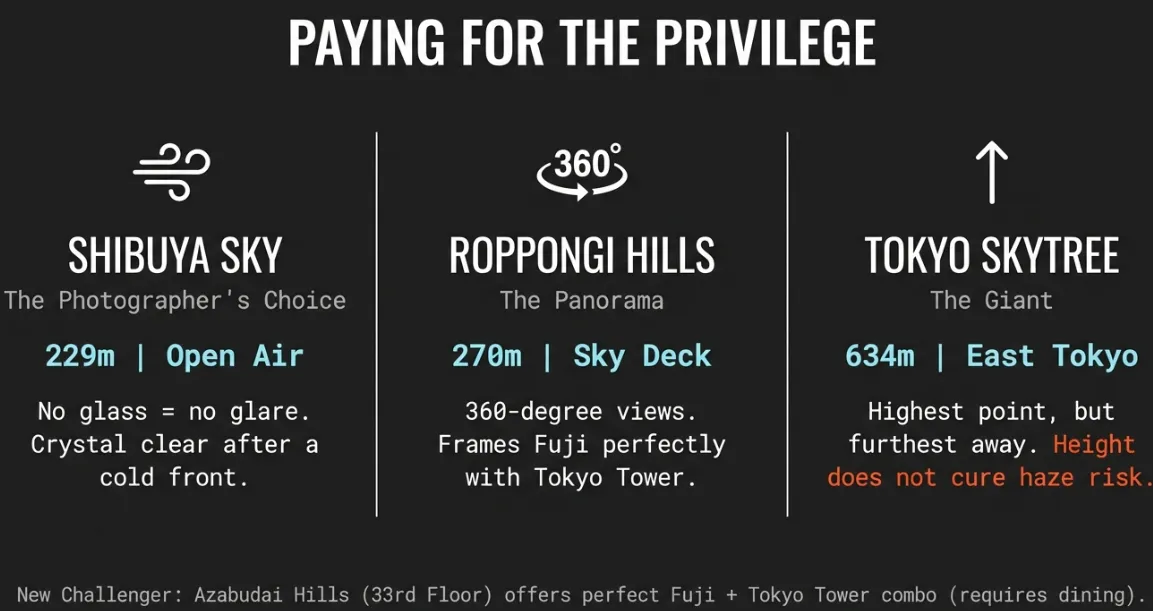
The rooftop deck at Shibuya Scramble Square (229 meters) is Tokyo's most dramatic open-air observation platform. No glass between you and the sky. On a rare, perfectly clear day, the unfiltered view toward Fuji is unbeatable — especially after a cold front when the air is absolutely crystal.
- Cost: ¥2,500 (adults, online)
- Hours: 10:00 AM – 10:30 PM
- Nearest station: Shibuya
- Why I love it: Open-air eliminates glare issues; phenomenal for photography
4. Roppongi Hills Tokyo City View + Sky Deck — Best Premium Option
The 52nd-floor City View observation deck in Mori Tower features floor-to-ceiling glass with a full 360-degree panorama. The real prize is the rooftop Sky Deck at 270 meters — an open-air platform that's superb after a front passes through. The southwest-facing section gives you Fuji with Tokyo Tower in the foreground.
- Cost: ¥2,200 (City View); ¥500 additional for Sky Deck
- Hours: 10:00 AM – 10:00 PM (City View); Sky Deck hours vary
- Nearest station: Roppongi
5. Tokyo Skytree — Highest Vantage Point
At 634 meters, Tokyo Skytree is the tallest structure in Japan. The Tembo Deck (350m) and Tembo Galleria (450m) are staggeringly high, and on clear days, Fuji appears beyond the sprawl in the distance. However, the extra altitude doesn't dramatically improve atmospheric visibility — if haze is the issue, being higher doesn't help much. The Skytree is also located in eastern Tokyo, putting it farther from Fuji than most western-side decks.
- Cost: ¥2,100–¥3,100 (varies by deck and timing)
- Nearest station: Tokyo Skytree / Oshiage
6. Azabudai Hills — Newest Contender
The observation area on the 33rd floor of Azabudai Hills doesn't offer a full 360-degree view, but its roughly 180-degree southwest-facing panorama may be the single best framing of Tokyo Tower and Mt. Fuji together. Access requires dining or drinking at one of the 33rd/34th floor establishments (Dining 33 or Sky Room Cafe & Bar).
- Nearest station: Kamiyacho or Azabu-Juban
If you're interested in how it stacks up against other decks, read our full ranking of Tokyo observation decks.
Beyond the Towers: Other Ways to See Fuji from Tokyo
Observation decks aren't your only option. Some of my most memorable Fuji sightings have been from unexpected places.
From a Hotel Room
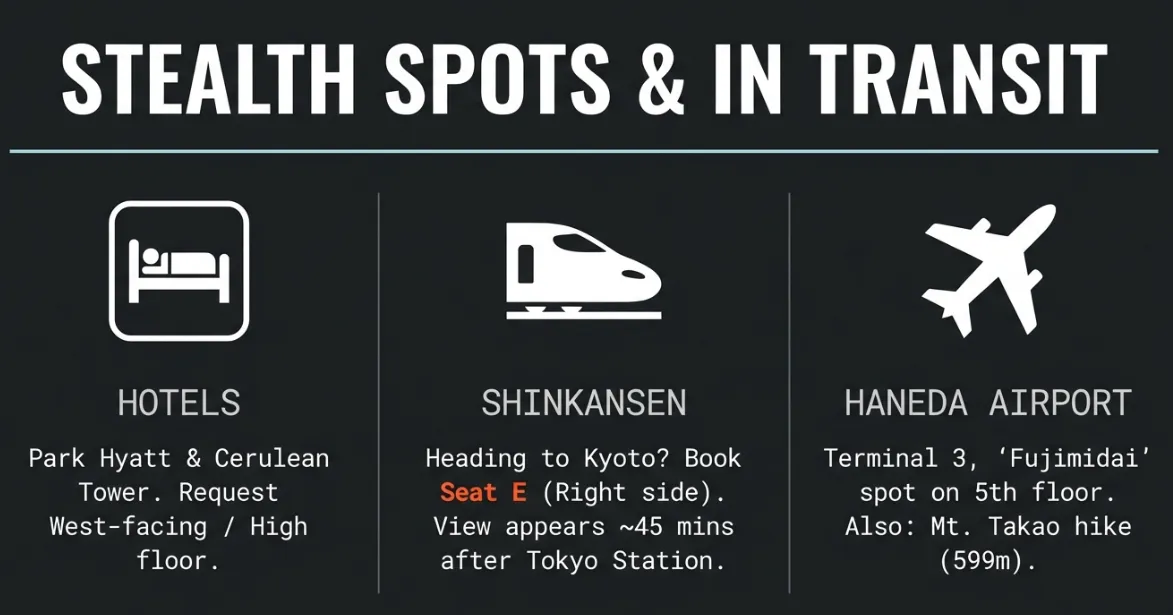
Several Tokyo hotels offer rooms with Mt. Fuji views on clear days. The Tokyo Metropolitan Government Building area hotels in Shinjuku tend to have the best angles. Hotels like the Park Hyatt Tokyo (made famous by Lost in Translation), the Cerulean Tower Tokyu in Shibuya, and the Tokyo Dome Hotel near Korakuen have rooms with westward views that occasionally reveal Fuji. Always request a west-facing room on a high floor and cross your fingers.
From Haneda Airport
If you're flying in or out of Tokyo, the observation decks at Haneda Airport (Terminal 1, 6th floor, and Terminal 3 rooftop) offer surprisingly good Fuji views. The Fujimidai viewing spot at the far north end of Terminal 3's 5th-floor deck is specifically positioned for it.
From Mt. Takao
Just 50 minutes from Shinjuku by train, Mt. Takao (599m) offers Fuji views from its summit on clear days. You can take the ropeway partway up and hike the rest — a pleasant two-hour walk. This is one of the closest places to central Tokyo where you can combine nature, exercise, and a Fuji view.
From the Shinkansen
If you're heading to Kyoto or Osaka, don't sleep through the Fuji section. About 40–45 minutes after departing Tokyo Station, Mt. Fuji appears on the right side of the train (seat E in standard cars, seat D in Green Cars). The best views come around Shin-Fuji Station. It's fleeting but magnificent.
Want a Guaranteed View? Take a Day Trip
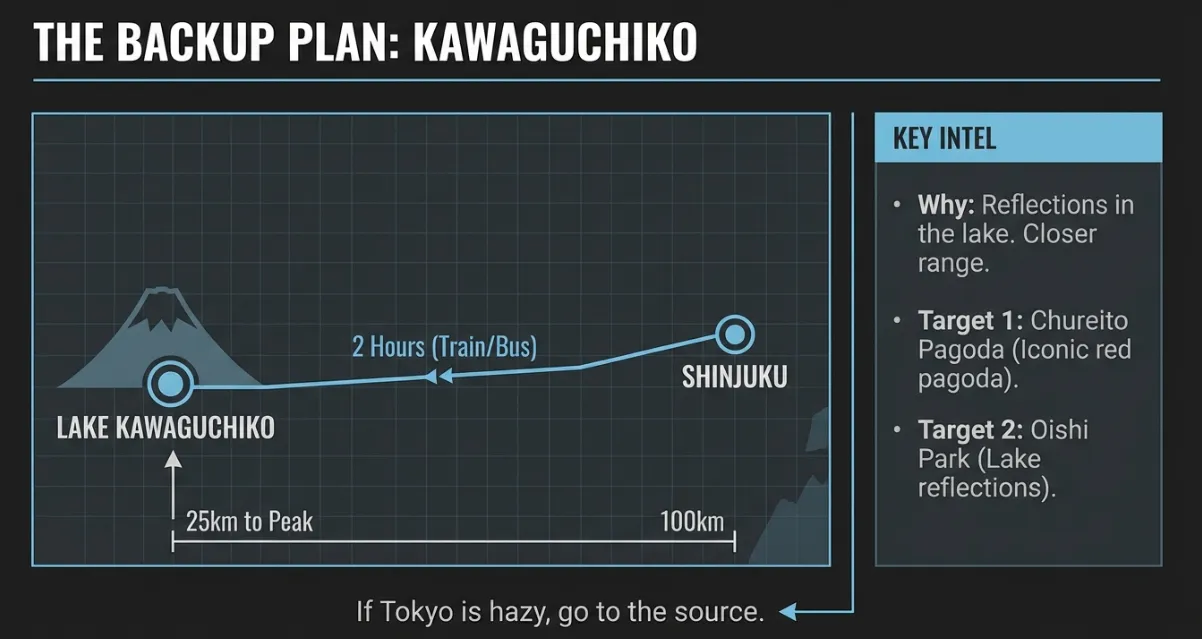
I'll be honest: if seeing Mt. Fuji is a non-negotiable bucket list item, relying on the Tokyo skyline view alone is risky. For a dramatic, up-close experience, take a day trip to the Fuji Five Lakes region — specifically Lake Kawaguchiko, about two hours from Shinjuku by direct train or bus.
Why Kawaguchiko Delivers
Lake Kawaguchiko sits at the northern base of Mt. Fuji, just 25 kilometers away. The air is cleaner, the elevation higher, and the views are infinitely more dramatic than anything you'll see from a Tokyo skyscraper. On calm mornings, you can photograph Fuji reflected perfectly in the lake's surface. The northern shore of the lake is the sweet spot for that iconic composition.
Must-visit spots near Kawaguchiko:
- Chureito Pagoda — The five-storied pagoda with Mt. Fuji in the background is probably the most photographed scene in Japan. In April, cherry blossoms frame the shot perfectly.
- Oishi Park — A free, flat walking path along the lake's northern shore with seasonal flowers and unobstructed Fuji views. Great for families.
- Mt. Tenjo Ropeway — Ride up for eye-level views of Fuji from about 1,000 meters, complete with giant swings overlooking the mountain.
- Oshino Hakkai — A natural spring village with traditional thatched-roof houses and gorgeous Fuji reflections in the crystal-clear water.
Getting There
- Train: The Fuji Excursion limited express runs directly from Shinjuku to Kawaguchiko (about 2 hours, around ¥4,130).
- Highway bus: Runs from Shinjuku Bus Terminal, takes about 2 hours (around ¥2,200 one-way). Budget-friendly but subject to traffic.
- Guided tour: If you'd rather not navigate logistics, guided day tours from Tokyo cover Chureito Pagoda, Oishi Park, and other highlights in a single day. They typically depart from Shinjuku early in the morning.
Photography Tips for Shooting Fuji from Tokyo
Over dozens of attempts, I've dialed in a few techniques that make or break a Tokyo-to-Fuji photo.
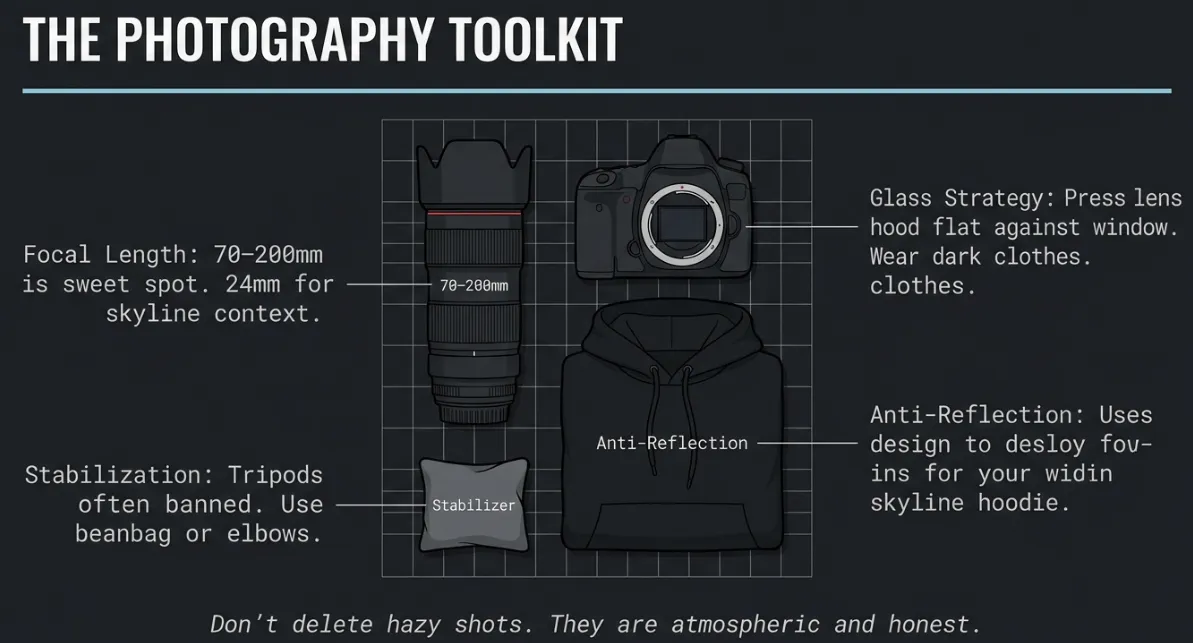
Lens choice: Phones look best at 2x to 5x zoom. For cameras, a 70–200mm lens (full-frame equivalent) brings Fuji to a satisfying size in the frame. A 24mm wide-angle is great for "Fuji amid the skyline" compositions.
Dealing with glass: Observation deck windows are your enemy. Wear dark clothing to reduce reflections, press your lens hood or hand flat against the glass, and skip polarizing filters — they often make reflections worse through thick windows.
Timing for light: Just after sunrise, eastern light illuminates Fuji's face beautifully. Late afternoon puts the mountain in dramatic silhouette. The golden 30 minutes around sunset are magical if conditions hold.
Stability: Tripods and monopods are restricted at most Tokyo observation decks. A beanbag rested on the railing edge, or simply bracing your elbows against the glass, works well.
Don't delete the hazy shots. Some of my favorite Fuji-from-Tokyo images have Fuji as a ghostly silhouette emerging from the mist. It captures the feeling of the experience more honestly than a razor-sharp telephoto image.
For more photography techniques, check out our Photography Guide: 7 Best Spots.
The Diamond Fuji Phenomenon
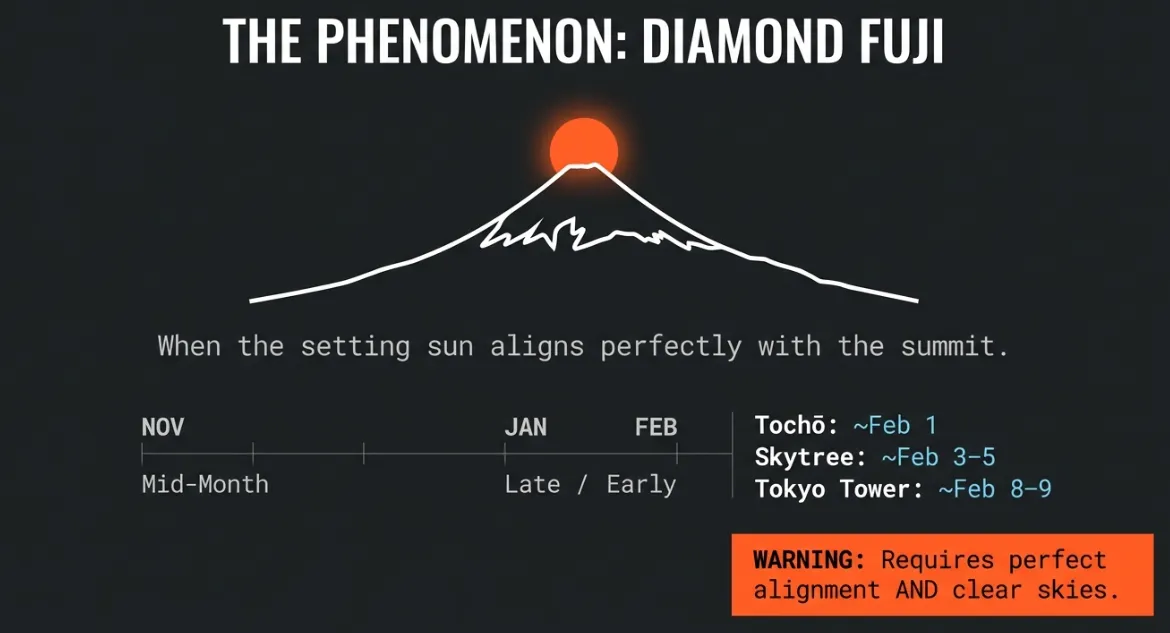
Twice a year from central Tokyo, the setting sun aligns perfectly with Mt. Fuji's summit, making the peak glow like a diamond. This "Diamond Fuji" event lasts only minutes and is visible from Tokyo observation decks typically in late January to early February and again around mid-November.
Each deck has slightly different optimal dates depending on its exact position. Tokyo Tower's Diamond Fuji window falls around February 8–9, while the Tokyo Metropolitan Government Building aligns closer to February 1, and Shibuya Sky a few days later. Tokyo Skytree typically sees it around February 3–5 and November 6–8.
Word of warning: You need both perfect sun alignment AND clear skies. Clouds anywhere along the western horizon will ruin the show. Check forecasts obsessively the week before, and have a backup plan.
My Personal Fuji-from-Tokyo Strategy
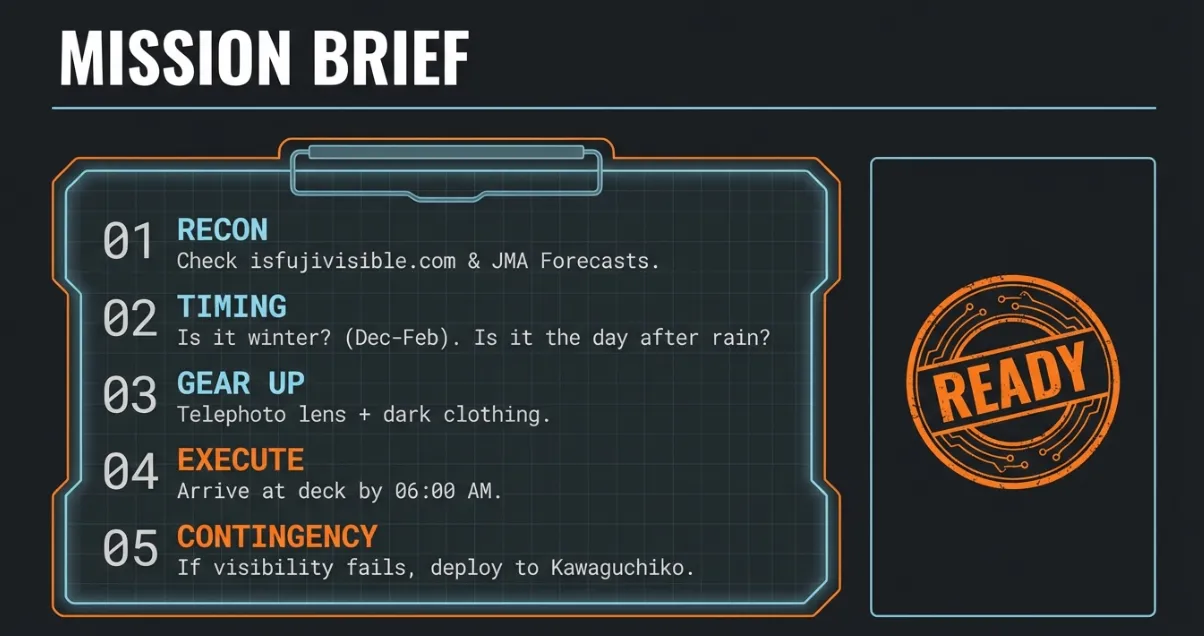
After years of trial and error, here's exactly what I do when I'm in Tokyo and want to see Fuji:
- Check the forecast the night before using isfujivisible.com and Japan Meteorological Agency reports. Look for clear skies, low humidity, and northwesterly winds.
- If conditions look good: Head to the Bunkyo Civic Center or Tochō right at opening for the free view. If it's a spectacular day, splurge on Shibuya Sky or the Roppongi Hills Sky Deck for the open-air experience.
- If conditions are marginal: Visit Tokyo Tower anyway — the city view is worth it regardless, and you might get lucky with a partial Fuji sighting.
- If Fuji is a must-see: Book a day trip to Kawaguchiko for the next clear morning. The two-hour journey dramatically improves your odds.
- Keep your eyes open. Some of my best Fuji sightings were completely unexpected — through a gap between buildings while walking in Shibuya, from a bridge over the Tama River, or from an airplane window descending into Haneda.

Quick Reference: Fuji Visibility Cheat Sheet
| Factor | Best Conditions | Worst Conditions |
|---|---|---|
| Month | December – February | June – September |
| Time of day | 6:00 – 9:00 AM | Afternoon |
| Weather pattern | Day after cold front/rainstorm | During or after prolonged humidity |
| Season for snow cap | Late November – May | June – October (bare peak) |
| Diamond Fuji (from Tokyo) | Late Jan / early Feb, mid-Nov | Rest of year |
Final Thoughts
Seeing Mt. Fuji from Tokyo is one of those travel experiences that rewards patience and planning. It's not the effortless, guaranteed postcard moment that some travel blogs promise — it's better. When you've checked the forecasts, woken up early, ridden the elevator to the top of Tokyo Tower, and then that unmistakable snow-covered cone materializes out of the morning haze 100 kilometers away... it genuinely takes your breath away.
Even if Fuji hides during your visit, Tokyo's skyline views are spectacular on their own. And if you really want the sure thing, Kawaguchiko is just two hours away, waiting to deliver one of the most beautiful mountain views on the planet.
Happy Fuji hunting.
Continue Exploring
Planning your visit to Tokyo Tower? Check out our Complete Tokyo Tower Visitor's Guide for everything you need to know about tickets, observation decks, dining, and the best times to visit.
Want to capture the perfect shot? Read our Photography Guide: 7 Best Spots for camera settings, seasonal tips, and creative techniques.
Curious about what's nearby? Discover the Offbeat Gems Near Tokyo Tower that most tourists miss.